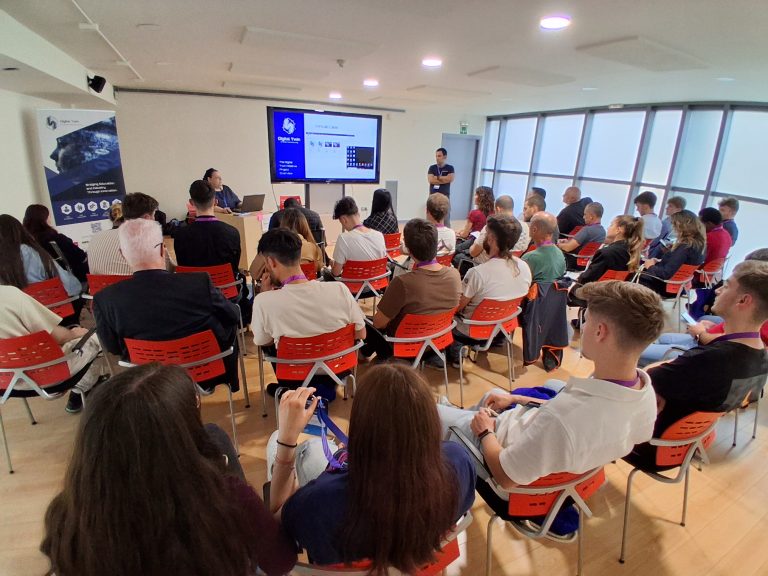
The “Digital Twin in Smart Manufacturing” project is advancing rapidly in the development of its training course, aimed at preparing participants for the challenges of Industry 4.0. At the second project meeting in Bilbao, Spain, partners discussed the progress of training modules and key topics to be covered in the course. With over 450 hours of training, this course will provide both theoretical and practical knowledge necessary for the successful application of Digital Twin technology in industrial processes.
Core Training Modules
The project offers a training course consisting of 10 modules covering a wide range of topics, including automation, cybersecurity, virtual commissioning, and green technologies. Each module is carefully crafted to equip participants with essential skills and competencies.
- TM1 – Introduction (60 hours)
This module covers fundamental topics like PLC programming, 3D drawing, and IoT integration. Participants will also receive an introduction to programming with Python and C#, building a solid foundation for the following modules. - TM2 – Digital Twins (45 hours)
A theoretical module providing an overview of Digital Twin technology across three levels: 2D, 3D, and Virtual Commissioning. This module prepares learners to understand core concepts related to digital manufacturing. - TM3 – Virtual Commissioning (60 hours)
Through practical exercises, learners will understand how virtual commissioning works and how to simulate real-world manufacturing scenarios before implementation. - TM4 – Virtual Maintenance (60 hours)
A highly theoretical module focused on maintaining systems through virtual models, helping learners understand how to efficiently maintain equipment, even remotely. - TM5 – Business Intelligence (45 hours)
This module trains participants to use business intelligence tools to enhance decision-making by analysing data from Digital Twins. - TM6 – Virtual Environment and Artificial Intelligence (45 hours)
Participants will delve into artificial intelligence and extended reality, learning how these technologies integrate with Digital Twin solutions. - TM7 – Industrial Cybersecurity (45 hours)
Focusing on the critical need for industrial system protection, this module teaches cybersecurity protocols within a Digital Twin environment. - TM8 – Other Technologies (45 hours)
This module explores key technologies such as robotics, reverse engineering, and cloud computing, providing essential skills for modern manufacturing environments. - TM9 – Green Transition (25 hours)
Introducing sustainable manufacturing practices, this module emphasizes the impact of Digital Twin technology on energy efficiency, waste management, and environmental preservation. - TM10 – Entrepreneurship and Incubator Setting (20 hours)
This module equips learners with entrepreneurial skills, teaching them how to develop and manage startups and incubators related to Digital Twin technology.
Hands-On Training and Future Opportunities
A significant part of the training will be conducted through Digital Twin labs, offering participants the opportunity to simulate real industrial processes in a secure virtual environment. This provides practical experience that can be directly applied in the workplace.
Upon completing the course, participants will be prepared to take on roles in industrial manufacturing, automation, cybersecurity, and sustainable technology. They will be equipped to lead projects in companies implementing modern technologies for optimizing production processes and sustainable development.
Next Steps
During our second meeting in Bilbao, we have made comprehensive plans for the next steps of the project. As the training modules advance, pilot testing is planned for 2025 to evaluate the course content and gather participant feedback. Additionally, skills competitions will be held, providing trainees the chance to demonstrate their acquired knowledge in real-world settings.
For more information and updates on the training course and project progression, follow us on: LinkedIn || Facebook