Virtual Commissioning: Virtualisation as an Industrial Standard
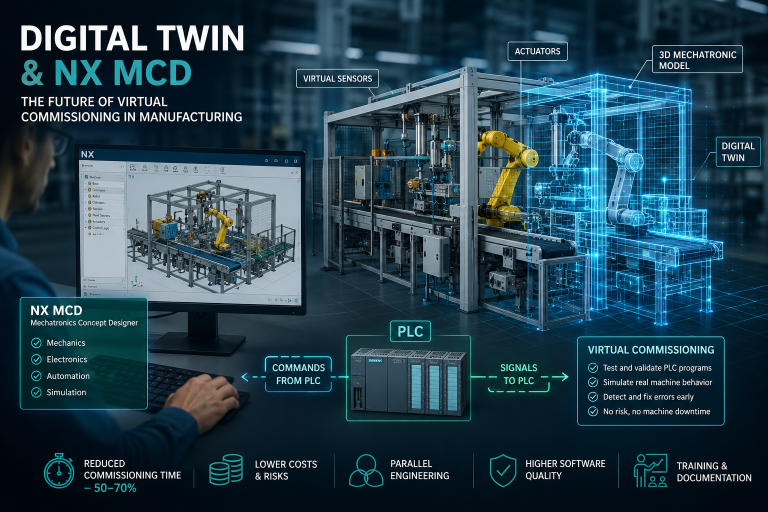
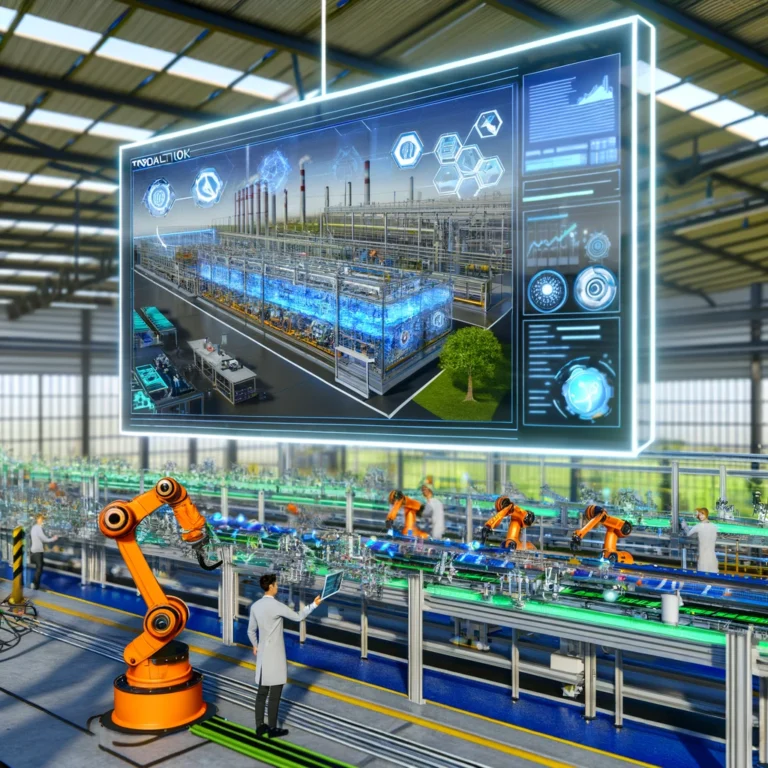
Within the Industry 4.0 paradigm, the Digital Twin is not merely a visual replica; it is the core of Virtual Commissioning. This technology enables simulation of the entire production system in a high-fidelity digital environment before any physical components are installed.
Through the Digital Twin, engineers can precisely determine the optimal spatial configuration of a robot within its work cell. This preemptive simulation is essential not only for positioning but also for design and predictive maintenance. It enables validation of control logic and machine interactions, significantly reducing operational risks and physical setup costs.
Depending on the robot’s kinematic type—ranging from simple Cartesian, SCARA (Selective Compliance Assembly Robot Arm), anthropomorphic (or articulated), polar, to the widely used parallel and delta configurations—each requires specific positioning to optimise both payload capacity and operational speed.
Often, the robot’s kinematic characteristics are carefully analysed during the preliminary design phase to select the appropriate configuration, but are then overlooked during implementation.
This leads to a series of issues that can seriously compromise the machine or system’s operational performance:
- The need to increase acceleration and speed to meet the projected cycle time
- The emergence of vibrations that cause the tool to lose grip on the manipulated product, while also accelerating mechanical wear
- Efficiency problems that fall short of theoretical expectations
- Notable motion anomalies, such as mechanical jerks, can be caused, for example, by motor rotation reversals during trajectory execution. It’s important to note that the shortest spatial path does not always correspond to the shortest cycle time
- Increased mechanical wear, leading to unexpected failures and a general rise in mechanical maintenance frequency
Technical Analysis: Advanced Kinematics and Motion Optimisation
Integrating robotic kinematics into the Digital Twin elevates design beyond geometric modelling, enabling dynamic and analytical control of mechanical behaviour.
Technical Advantages and Workflows
- Precision and Path Planning: Algorithmic definition of trajectories prior to physical deployment ensures smooth execution, free of deviations and vibrations.
- Validation and Collision Detection: Preemptive testing in a virtual environment eliminates the risk of mechanical interference between the robotic arm, end effector, and surrounding infrastructure.
- Reachability Analysis: In-depth study of work volumes ensures that every point in the operational cycle is accessible without excessive mechanical strain.
Managing Critical Constraints
- Singularity Points: The Digital Twin enables the preemptive computation of the Jacobian matrix, thereby identifying geometric configurations in which the robot would lose degrees of freedom. This prevents infinite joint velocity spikes and potential system lockups.
- Joint Extension Limits: Continuous monitoring of mechanical constraints within the work envelope prevents abnormal stresses and helps ensure the longevity of hardware components.
Performance Objectives: Efficiency and Operational Resilience
Kinematic optimisation through the Digital Twin has a measurable impact on productivity. Superior motion planning not only reduces Cycle Time but also improves key industrial performance metrics:
- Reduced Lead Time: Accelerated design and virtual testing phases enable faster time-to-market.
- Optimised MTTR (Mean Time To Repair): Integration with virtual diagnostics facilitates rapid fault identification, reducing average repair times.
- Energy Sustainability: Smoother trajectories minimise energy consumption peaks, aligning production with green transition goals.
Conclusions
Integrating the Digital Twin into the design and optimisation of industrial robotics marks a paradigm shift in Smart Manufacturing. The ability to simulate, analyse, and validate every aspect of robotic kinematics in a virtual environment—from selecting the most suitable configuration to managing mechanical constraints—allows for early detection of critical issues, drastically reduces commissioning times, and enhances the overall quality of the production system. This advanced approach not only boosts operational efficiency and system resilience but also promotes greater energy sustainability and cost reduction throughout the plant’s lifecycle. In an industrial context increasingly driven by flexibility and precision, the Digital Twin is an essential tool for ensuring high performance, reliability, and competitiveness.