Artificial intelligence has redefined what digital twins can be. Once static simulations used to monitor physical systems, digital twins have evolved into intelligent entities that learn, adapt, and make decisions. These AI digital twins are not merely virtual copies, they are self-improving models that bridge the physical and digital worlds through continuous learning and predictive insight.
An AI digital twin combines data from sensors, machines, and environments with machine learning algorithms that interpret and anticipate behaviour. Unlike traditional models that simply reflect conditions, AI-driven twins analyse patterns, forecast outcomes, and propose actions in real time. This makes them invaluable in sectors like manufacturing, energy, healthcare, and urban planning. A factory can use an AI twin to optimize production and prevent breakdowns, while a hospital might rely on one to simulate a patient’s response to treatment, enabling precise and personalized care.
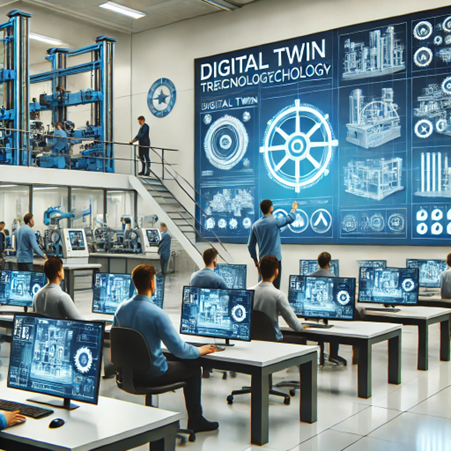
In modern factories, AI digital twins offer tangible and transformative advantages. By continuously monitoring machines and production lines, they can predict equipment failures long before they happen, reducing downtime and maintenance costs. They optimize resource use by adjusting processes in real time to minimize waste, energy consumption, and material inefficiencies. Through advanced simulations, AI twins allow manufacturers to test new configurations or production methods virtually, without interrupting actual operations. Moreover, their ability to learn from data across entire facilities creates a self-optimizing ecosystem, where production becomes not just efficient, but intelligently adaptive to changing demands and market conditions.
The true power of AI digital twins lies in their autonomy. By processing massive amounts of real-time data, they continuously refine their understanding of the systems they represent. This allows them to detect inefficiencies or risks before they escalate and to simulate alternative strategies instantly. In smart cities, for example, AI twins can balance energy demand, reduce traffic congestion, and respond dynamically to environmental changes. They not only observe reality, but they also shape it.
As AI, edge computing, and high-speed connectivity continue to advance, AI digital twins will become fundamental to how industries operate and innovate. They mark a shift from reactive problem-solving to proactive optimization, allowing systems to evolve alongside their human creators. More than a technological tool.