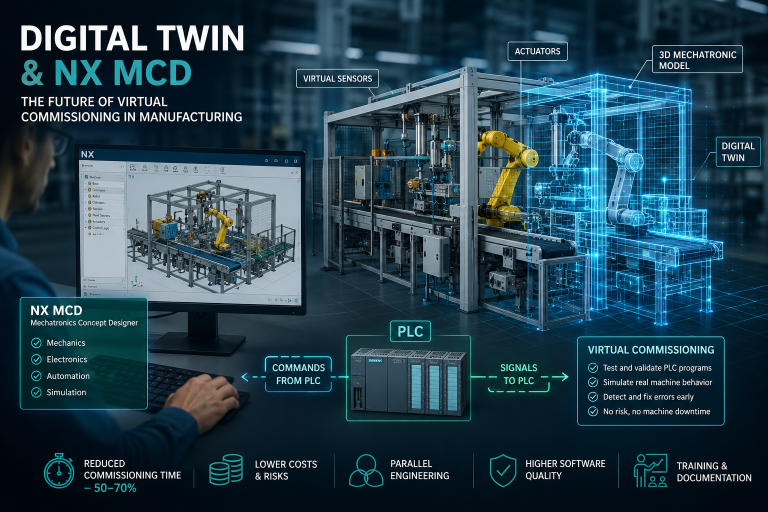
Imagine being able to create a perfect virtual copy of a product, a machine, or even an entire industrial plant. Not just to look at it, but to test it, improve it, and predict how it will behave in the real world. That’s the power of the Digital Twin.
What Is a Digital Twin?
A Digital Twin is a digital representation of a physical object. It can be an engine, a production line, a building, or a vehicle. But it’s not just a 3D “photo”: it’s a dynamic model that updates in real time using data collected from sensors and software.
With the Comprehensive Digital Twin, Siemens takes this technology to the next level. It doesn’t just simulate the product—it also models how it’s designed, built, used, and maintained. It’s like having a virtual version of the entire lifecycle.
Why Is It So Revolutionary?
– Saves time and money: ideas and solutions can be tested before anything is physically built.
– Improves quality: problems can be identified before they occur.
– Reduces environmental impact: processes are optimized to consume fewer resources.
– Prevents failures: thanks to data, maintenance can be performed before something breaks.
How Does It Work?
At the core is Siemens Xcelerator, a platform that connects software, hardware, and services. It enables companies to:
– Collaborate across engineering, design, and technical teams.
– Simulate complex scenarios.
– Integrate artificial intelligence to make smarter decisions.
– Create realistic virtual environments, thanks to partnerships with NVIDIA and AWS.
The Different Types of Digital Twins
Companies need a range of capabilities to deploy digital twins, including CAD modelling, product management, connectivity, Industrial Internet of Things (IoT) software, remote monitoring, and physics-based simulation. This is because digital twins are not a single technology, but a composition of solutions that aim to bridge the physical and digital worlds—from design and simulation, through manufacturing, assembly, and after-sales service.
As a result, there are different types of digital twins, delineated based on their level of fidelity.

In Conclusion
The Comprehensive Digital Twin is not science fiction—it’s already a reality. And it’s transforming how companies design, produce, and manage their products. It’s a technology that makes industry smarter, more sustainable, and more competitive.