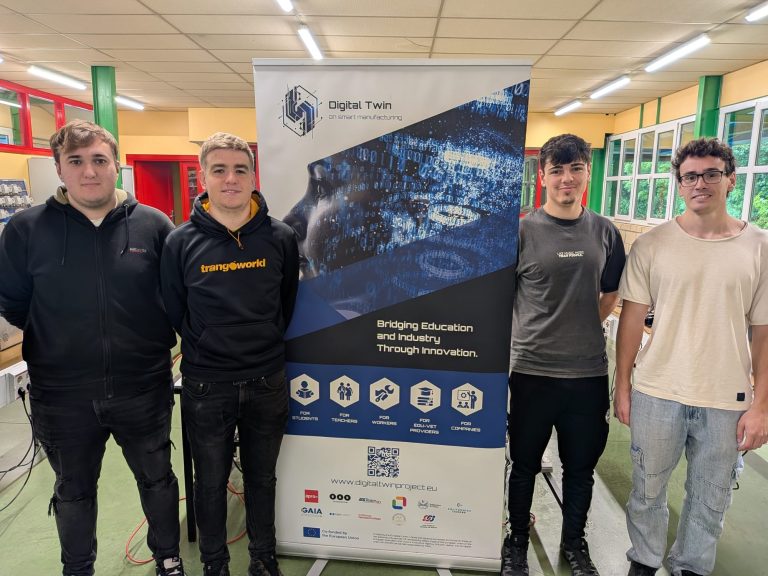
The European Researchers’ Night 2025 was a significant occasion to showcase the progress of Digital Twin on Smart Manufacturing project and to engage with a wide audience composed of citizens, students, and professionals. The event was not only a celebration of scientific research, but also an opportunity to foster dialogue between researchers and the public, highlighting the tangible value of innovation and the role of new technologies in shaping the future.
A central part of the presentation was dedicated to the training modules developed within the project. These modules are designed to provide structured and accessible educational content, aimed at strengthening skills in emerging areas of digital innovation. During the event, participants had the opportunity to explore the methodology behind the modules, as well as their practical use in academic and professional settings. The clarity of the structure and the adaptability of the materials received positive feedback, demonstrating their potential as a valuable resource for learning and training.
In addition to the training content, particular emphasis was placed on the project’s case studies, which leverage virtual reality to create collaborative environments. These environments allow multiple users to interact in real time within a shared virtual space, simulating situations that go beyond the limits of traditional learning or testing scenarios. Visitors could observe demonstrations of how immersive technologies can be used not only to enhance engagement, but also to provide measurable benefits in terms of user-friendliness and effectiveness.
Among the case studies presented, those designed to support the assessment of students within the Moodle platform generated strong interest. These virtual reality environments were showcased as innovative tools capable of enriching the traditional evaluation process, making it more interactive, dynamic, and closer to real-world applications. The audience appreciated the potential of these tools to create fairer, more engaging assessments that can adapt to different learning contexts and individual needs.
The initiative not only highlighted the results achieved so far but also reinforced the vision of a future in which digital technologies, and virtual reality in particular, can significantly contribute to education, collaboration, and scientific progress.