The design of a product has long been a balance between performance, cost, quality, and meeting market needs. In recent years, a new factor has gained importance in the design process: sustainability.
Sustainability asks: What is the overall environmental impact over the entire lifecycle of a product?
About 80% of a product’s environmental footprint is determined in the development and design phase. It is in this phase that decisions are made about materials, their sources, production methods, energy efficiency, including carbon emissions and resource use, and the end-of-life strategy for the product. These initial decisions affect the design and production options available in later stages.
However, sustainability considerations must extend beyond a single company’s operations. They should include suppliers, distributors, and logistics partners to capture a complete environmental picture.
The earlier these decisions are made in the design process, the greater the potential for sustainable and economically beneficial outcomes in both the product and production processes.
The Role of Data and Digitalization
Data and digitalization are essential for implementing a holistic design approach. Digital tools allow companies to create a complete digital twin, which can be used to simulate, test, and validate a product throughout its entire lifecycle.
Digital Tools for Sustainable Development
Modern products often involve complex systems that require input from various engineering disciplines. This complexity demands reliable digital environments that support collaboration and innovation.
Simulation tools are an example of how digitalization supports the development of sustainable products. Designers and engineers can use these tools to test and optimize individual components and ensure cohesive performance between different systems and the entire production process.
By integrating sustainability assessments from the outset, teams can make better-informed decisions. Evaluating factors such as emissions, material sourcing, and production waste during the design phase helps define an intelligent, sustainable design space.
Creating a Complete Digital Twin
A complete digital twin that extends to production provides valuable insights into a product’s entire lifecycle—from logistical costs and operational efficiency to end-of-life options like reuse or recycling. Accurate data helps refine decisions and improve sustainability metrics, supporting competitiveness and cost control.
Integrating Sustainability Indicators
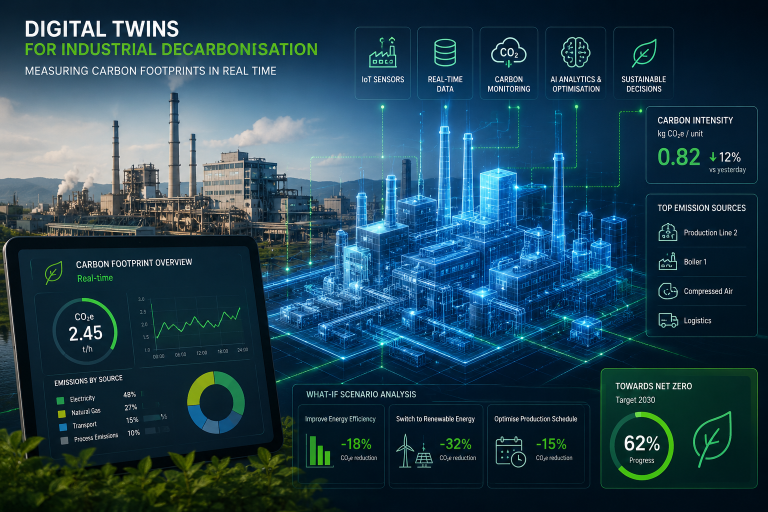
Sustainability indicators should be integrated into the digital twin from the start. This can include real-time data from physical sensors during production, delivery, and product use, paired with virtual sensors that use predictive models. Additionally, enterprise data can provide insights into factors such as carbon emissions and material costs.
The combination of physical and virtual sensors enriches simulations, allowing companies to make iterative improvements based on feedback. Artificial intelligence (AI) and machine learning can further enhance this process by identifying discrepancies and enabling adjustments through updates or collaborations with supply partners.
Designing for Sustainability
Industries face the challenge of innovating within the limits of finite resources. True sustainability means designing optimized products across the entire value chain. This requires a systems-based approach that leverages digital twins and a continuous flow of data between real and virtual environments.
Digitalization and automation generate an abundance of data, supporting the creation of complete digital twins that integrate physical and digital worlds. This ensures efficient resource use, paving the way for continuous optimization of products and processes.
Using data to explore various scenarios and predict future performance enables companies to design products with a full understanding of their environmental impact, leading to superior and more sustainable solutions.
By adopting these practices, we can move towards a world where sustainability and innovation go hand in hand.