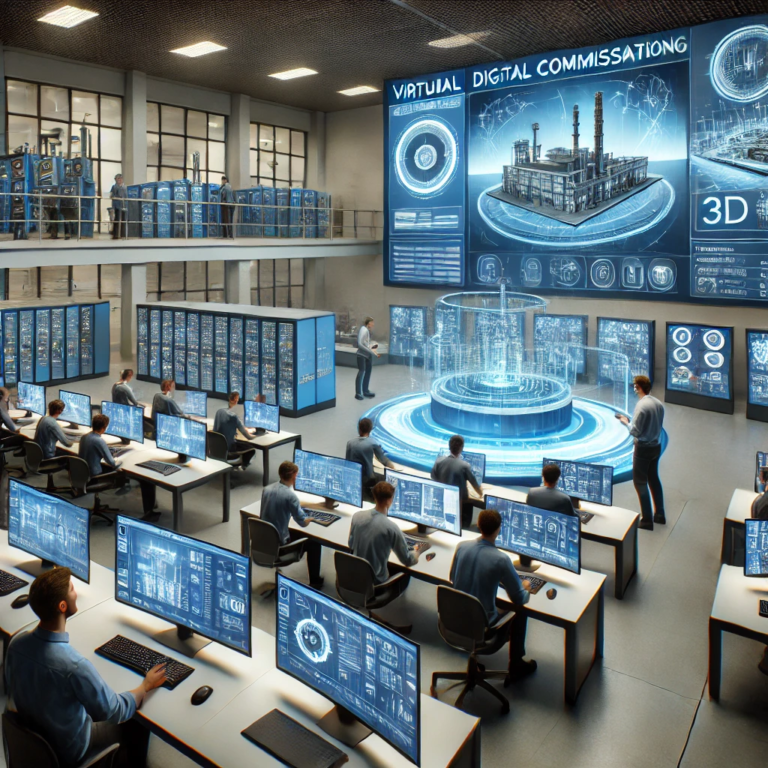
Training Module 6 – Virtual Environment offers an in-depth exploration of two transformative technological domains: Artificial Intelligence and eXtended Reality. Designed to provide both theoretical foundations and practical insights, it equips participants with the knowledge and skills needed to understand and apply cutting-edge techniques in these fields. From the fundamentals of machine learning and deep learning to advanced applications like Human Digital Twins, and from virtual reality environments to augmented and mixed reality systems, the course bridges the gap between AI-driven innovation and immersive extended reality technologies.
This course is structured into two main sections: Artificial Intelligence and eXtended Reality, each addressing crucial technologies and their applications.
The first section, focused on Artificial Intelligence, begins with an introduction to artificial vision systems. It provides an overview of computer vision and delves into the functionality and applications of RGB-D cameras, emphasizing various depth acquisition techniques such as passive stereoscopy, structured light, time-of-flight, and active stereoscopy. Additionally, this part explores essential image processing techniques aimed at preparing visual data for Machine Learning (ML) and Deep Learning (DL) algorithms.
Moving into the fundamentals of Artificial Intelligence, the module defines key principles and explains the different types of machine learning, presenting standard algorithms as a prelude to introducing deep learning. This section also emphasizes the importance of evaluation metrics, including the confusion matrix, accuracy, precision, recall, and F1-score, which are vital for assessing the performance of AI models.
The deep learning module concludes this section by tracing the history, potential, and challenges associated with this advanced field. Particular attention is given to performance optimization techniques, with a focus on data augmentation and its critical role. The course also highlights applications of deep learning in developing Human Digital Twins, especially for tracking human behavior for in-depth behavioral analysis.
The second section of the course shifts to eXtended Reality (XR), starting with an overview of the XR spectrum, covering Augmented, Mixed, and Virtual Reality. It examines head-mounted displays (HMDs), focusing on technologies like the Hololens 2 for augmented reality and the Meta Quest devices for mixed and virtual reality applications.
Next, the section delves into virtual reality environments, beginning with the fundamentals of 3D modeling and guiding participants through the process of creating a mesh from scratch. Participants will learn about texturing and shading, including the use of materials, colors, and lighting. This segment also introduces the basics of computer animation, emphasizing its role in enhancing user experience.
Finally, the Training Module explores augmented and mixed reality, starting with object tracking techniques that compare marker-based and markerless approaches. It also addresses user interface design, emphasizing how to develop applications using a user-centered approach to maximize usability and engagement.
This comprehensive Training Module provides participants with the theoretical foundations and practical skills to work with artificial intelligence and eXtended reality technologies, ensuring they are well-prepared for the challenges and opportunities in these rapidly evolving fields.